
Plymouth City Directory Collections
The strongest Plymouth city directory lead is a suburban run rather than one long, city-only series. Hennepin Library identifies New Hope, Plymouth, and Wayzata volumes in its digitized collections, while its Special Collections also keeps directories, maps, newspapers, yearbooks, and genealogy tools. Minnesota Historical Society finding aids add telephone volumes and archival routes. Each source has its own date range and scope, so record the volume title before treating an entry as a Plymouth result.
| Collection | Years | Where Held | Access |
|---|---|---|---|
| New Hope–Plymouth–Wayzata directories | 1964-1983 | Hennepin Library digital collection / ResCarta | Browse or search archival scans online; retain year and page. |
| Hennepin suburban directories | Suburban area 1956-1988 | Hennepin Library | Digital, print, or microfiche access varies by volume. |
| Plymouth telephone directories | 1960-1970 listed | Minnesota Historical Society finding aid | Confirm the physical volume and section with the archive. |
| Armstrong and county yearbooks | County 1890-1988; selected Armstrong years through 2025 | Hennepin Library | Some scans and listed print holdings provide school-year context. |
These are historical sources. A listing may support a dated address or affiliation, but it does not establish that anyone lives there now. The directory's own city selection, date, and scan page are part of the evidence.
Plymouth City Directory Scan Run
The digitized New Hope–Plymouth–Wayzata run is especially useful because its collection label names Plymouth and covers 1964 through 1983. Hennepin Library reported the addition in its 2025 digitization expansion. The search accepts case-insensitive text, with * for any characters and ? for one character. A wildcard cannot begin a term, and the collection does not use Boolean operators or quotation marks. Deselect other cities before judging a hit.
Hennepin Library's ResCarta directory browse shows the digitized collection where the New Hope–Plymouth–Wayzata scans can be selected.
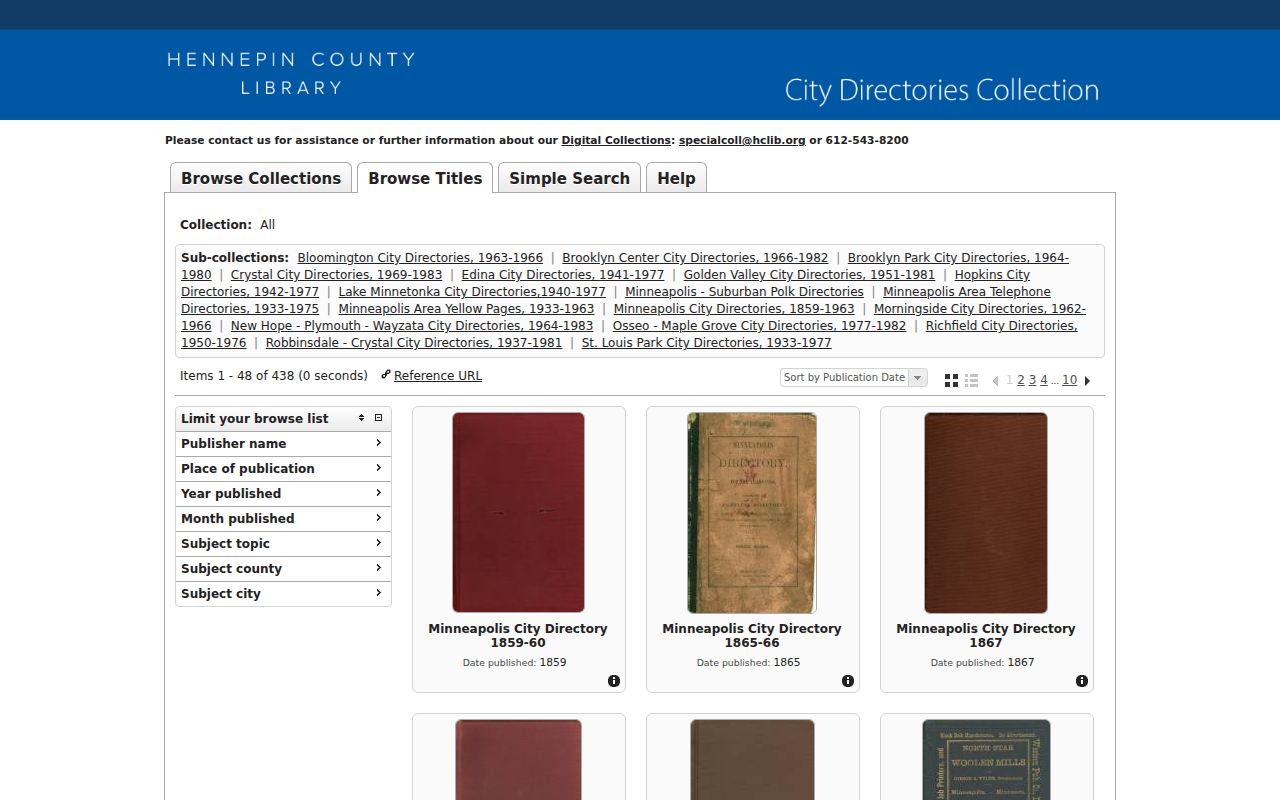
Use the collection title, selected city, year, page or scan identifier, and the printed address in a research note. OCR can misread surnames and numbers, so the image itself is the item to verify.
Note: A missing keyword hit can reflect OCR, an abbreviation, or a different directory scope rather than a missing historical household.
Plymouth City Directory Research Rooms
When a scan has a gap, Hennepin Library Special Collections is the practical next stop for directories, maps, yearbooks, newspaper clippings, census material, and library-only databases. The Plymouth History Center adds old newspapers, yearbooks, documents, photographs, and oral histories. Its research room is at 3605 Fernbrook Lane N; current Tuesday, Thursday, and first-Saturday access should be checked before a visit. These places make family, school, neighborhood, and address history possible without producing a modern resident list.
Hennepin Library's genealogy and local-history hub is the starting point for Special Collections and its connected directory, newspaper, map, and yearbook resources.
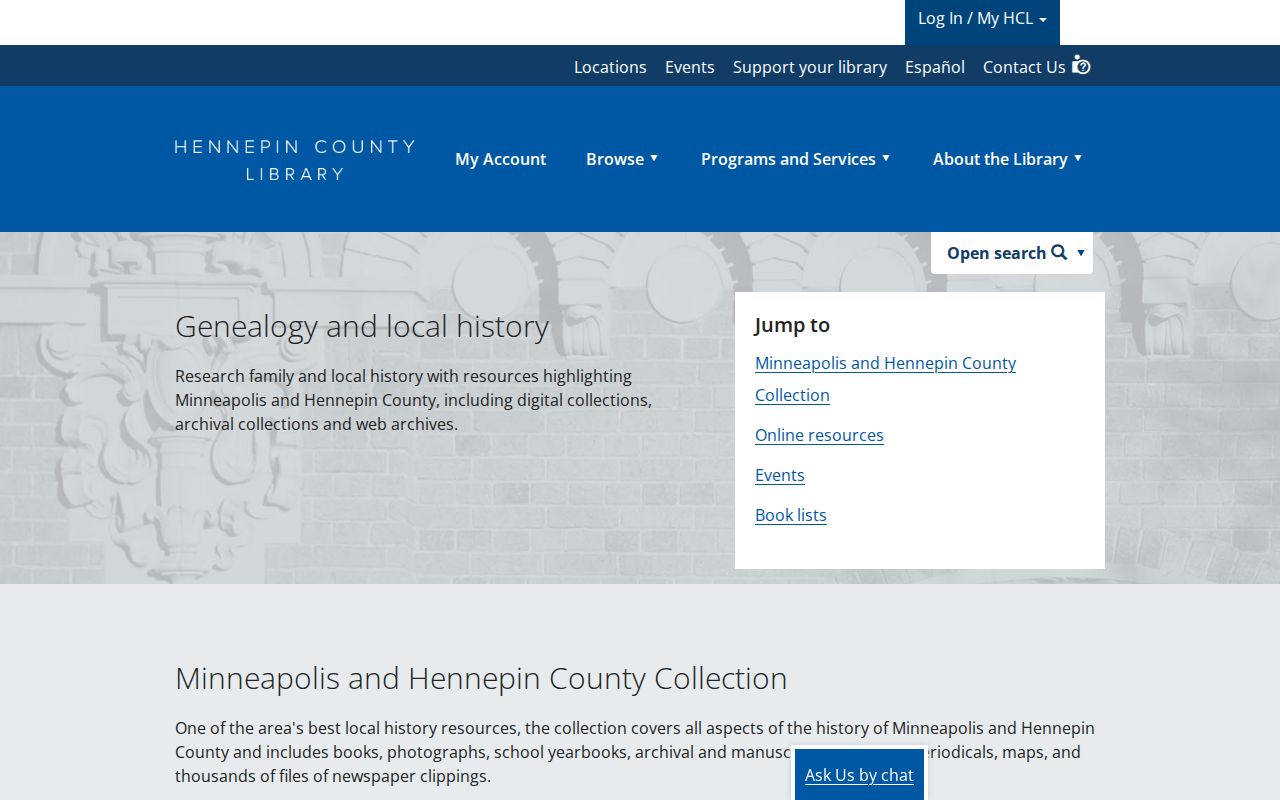
The hub helps separate online material from research that needs a library visit or staff assistance. Preserve the source type because a yearbook, newspaper clipping, and directory answer different historical questions.
Plymouth City Directory Companions
Telephone books, yearbooks, newspapers, plats, and archival finding aids can fill a missing year, but none should be silently substituted for a directory. Minnesota Historical Society's telephone finding aid lists Plymouth volumes for 1960, 1961 yellow-only, 1962 through 1967, 1968 and 1969 yellow-only, and 1970. Later holdings were not exposed in the research. A white or yellow section can differ, and an unlisted number says little by itself.
Hennepin Library's county yearbook collection spans 1890-1988 and lists selected Armstrong High School print holdings from 1971 through 2025. The Minnesota Digital Newspaper Hub reaches from 1849 to today, while the library's Star Tribune archive is library-only from 1867 forward. Hennepin clipping files and History Center material are useful fallbacks when there is no separate public Plymouth obituary index.
For broader archival searching, Minnesota Historical Society's collections search offers fields for names, dates, record types, and digital material.
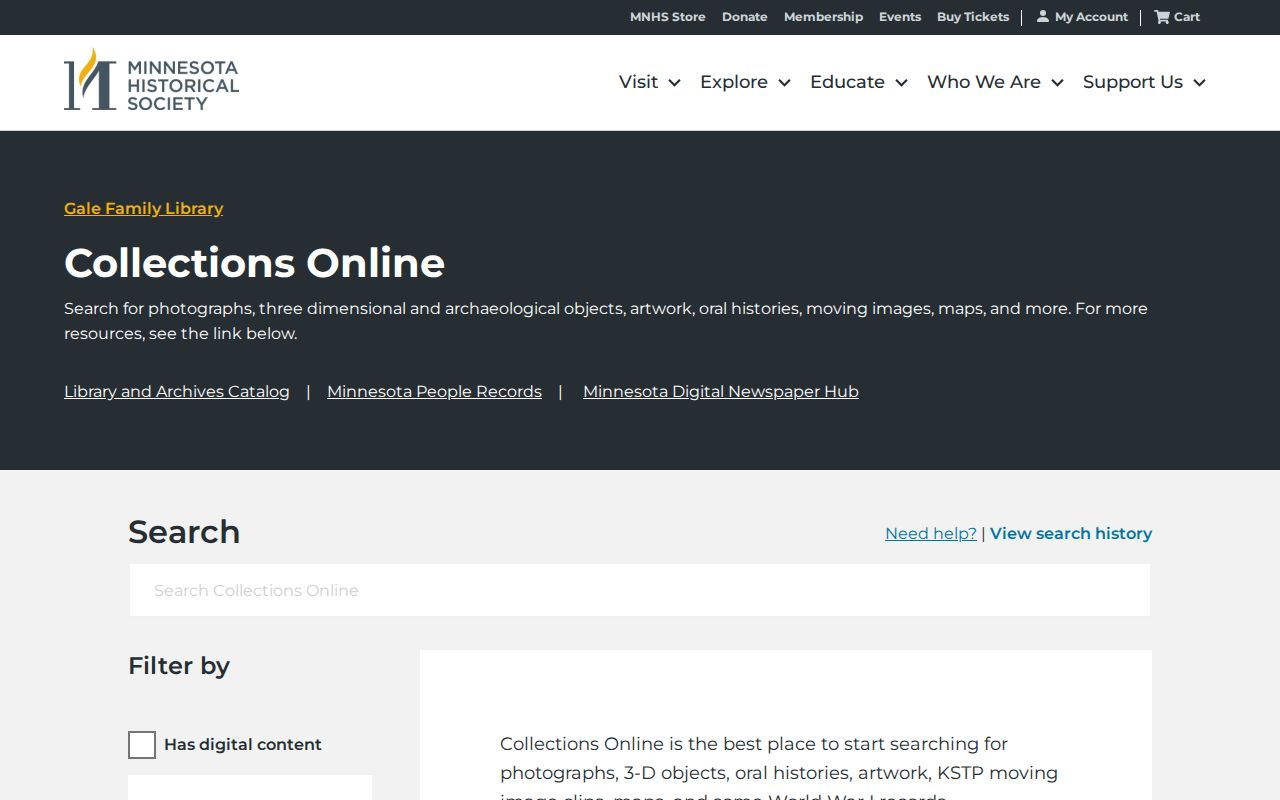
An archive result is a lead to the holding, not a replacement for its item description, access condition, or original scan. Some MNHS material is off-site or has private-record restrictions.
Reading a Plymouth City Directory Entry
A city directory entry is compact, and its meaning depends on the volume. A name may be shortened, a spouse may appear in parentheses, and ditto marks can repeat a surname or address. Occupation, affiliation, address, and a marker may be present, but their absence is not a finding. Earlier directories can omit spouses. Capture the printed line and its surrounding page context before translating an abbreviation into a conclusion.
| Printed name | Keep the surname and given-name form exactly as printed, including shortened forms such as Wm or Chas. |
|---|---|
| Address | Record the number, street spelling, direction, and suffix exactly, then note any normalized search form separately. |
| Spouse or affiliation | Parentheses and listed associations are time-stamped context, not proof of a current relationship. |
| h / r / b marker | Meanings can vary by year. Early r may not mean what a later volume means, and a prefix can run into a street number. |
| Page evidence | Keep collection title, year, page or scan ID, city heading, OCR confidence, and prior or next-year result. |
- Criss-cross directory
- A street-order section that can help locate historical entries by address instead of surname.
- Householder index
- An index arranged around the named household entry; check the volume's own introduction for its scope.
- Abbreviation key
- The volume's explanation of shortened terms and markers. Photograph or transcribe it with the entry because meanings can change.
Plymouth City Directory Search Forms
Try the name as printed and as a likely expansion. Search an address with and without a direction or suffix. Minneapolis volumes may use Av, omit a suffix, or print numbered streets as 1st, 2d, or 3d; suburban material also mixes abbreviated and spelled-out forms. For an address search, inspect adjacent entries and cross streets, then test both the year before and the year after a result.
Plymouth has an additional historical alias to retain. County Road 47 became Chankahda Trail in 2022, so a street-history search should preserve both strings. Older records can also use a county-road number, a subdivision name, or a rural form rather than a modern city label. Note: Street spelling changes should be saved as search variants, not silently overwritten in a citation.
Plymouth City Directory Timeline
Institutional dates help set reasonable expectations for a directory search. Plymouth moved from township and settlement history to village incorporation in 1955, a council-manager form in 1968, statutory-city status in 1974, and charter government in 1993. County records may therefore describe an older area through townships, plats, or rural routes. The digitized collection is a suburban directory run, not evidence that Plymouth shared a municipal government with the other places in its title.
- 1960-1970: MNHS finding-aid material lists the Plymouth telephone volumes and yellow-only years.
- 1964-1983: The New Hope–Plymouth–Wayzata directory scans supply the most specific digitized Plymouth run found.
- 2024: Plymouth History Center held its grand reopening after collections and facility work.
- 2025: Hennepin Library reported the suburban directory run as part of its digitization expansion.
Trace Plymouth City Directory Households
Start with one dated entry and build a small, auditable trail. A disappearance from a volume can mean a move, an omission, a changed spelling, an unlisted telephone number, or a publication gap. It does not prove a death or a new address. Pairing entries with census releases, parcel material, and newspaper or yearbook context helps distinguish those possibilities. The modern address route belongs with the Plymouth street directory lookup, while archival scans remain the best starting point for older households.
- Save the first usable entry with its collection title, city heading, year, page or scan ID, and exact printed name and address.
- Check the preceding and following volumes, including spelling, suffix, direction, and abbreviated-given-name variants.
- Search a criss-cross section where the volume provides one, and record adjacent addresses or businesses as page context.
- Pair the dated address with the appropriate census period, yearbook, telephone directory, plat, or newspaper source.
- Use the Hennepin property and Recorder routes only to test an address or document trail, keeping their dates separate from the directory date.
Historical reconstruction is strongest when two independent, time-stamped sources agree. A scan and a later parcel record should be described as different stages in an address history, not merged into one claim.
Plymouth City Directory Limits
City directories are selective publications, not complete rolls. The collection's coverage begins with the source itself, and the first or last Plymouth-specific printed volume has not been confirmed. Telephone holdings after 1970 also remain a research gap. A name can be absent because of a shortened form, city selection, OCR error, unlisted number, omission, or a gap between volumes. When a result matters, check the original scan and ask the holding library or archive about its volume inventory.
For a present-day name that needs careful confirmation, use a dated official record only when access rules permit and do not infer hidden details from a protected or blank result. Plymouth's 2026 permitting-scam warning is a useful reminder to verify any payment request through an official channel, even when a message uses real property or permit context.